XMEGA tutorial: what you should know (01)

|

Kurs XMEGA
Atmel’s AVR microcontrollers captured the imagination of thousands engineers around the globe. So far, the producer offered us two families: ATtiny and ATmega, which differ in pricing and possibilities, but the programming methodology for both is identical. Introducing the XMEGA, Atmel has done significant changes in the processors peripherals and, furthermore, changed the methods of software development. This tutorial is to let you learn, how to use XMEGA microcontrollers in practical applications and it will point the differences between them and conventional AVRs. We hope this course will encourage you apply XMEGA in your designs and fully take advantage of its innovative solutions.

Discover XMEGA

|

Don't stay behind! Discover new XMEGA from Atmel!
Links:
Atmel accomplished a quantum leap introducing new XMEGA microcontrollers. They are much faster, have more peripherals and their price is reasonable. Some of them are even lower cost than traditional ATmega. Don’t wait any longer. Step ahead to explore these fantastic units and use them to design much better devices.

ATxmega128A3U in DIL64


Let us introduce you to the new ATxmega128A3U development board from Leon Instruments. It is populated with every basic peripheral you need to get started with new XMEGA.


ATxmega128A3U peripherials:
  • 128kB Flash, RAM 8kB, EEPROM 2kB
  • 32MHz at 2.7V
  • 7x UART
  • 3X SPI
  • 2x I2C
  • 7X Timer
  • Full speed USB
  • 12-bit 2Msps ADC
  • 12-bit 1Msps DAC
  • Event system i DMA
  • AES/DES
  • Paraller interface for RAM, FPGA, itp.
  • ...and even more!

DIL64 package


With a X3-DIL64 prototyping module you are free to connect any device with ease and convenience. Plug it into the breadboard, just like any integrated circuit, program it and go! It’s so easy. The board’s dimensions are suited to fit conventional DIL64 packages, and pin order is exactly the same as in a processor’s TQFP64 package. That’s why you can apply this module to your EDA software without creating a new library.


Programming


ATxmega128A3U microprocessor can be programmed three ways:
  • PDI interface - it allows you to download/upload the memory and configure the device setting
  • FLIP bootloader - innovative Atmel’s solution for people who don’t own PDI nor JTAG programmer. Just plug in the usual USB cable and go! It’s the best solution for beginners
  • JTAG interface - although the JTAG connector isn’t present on the board, it’s possible to program and debug the device with the JTAG programmer
To improve the development of your software, we’ve populated the prototyping module with RESET and FLIP buttons. Just press them together to activate FLIP bootloader and you can download your software without a PDI/JTAG programmer. You only need an ordinary USB cable and nothing more!


Free to select the crystal


Don’t like the crystal oscillator hard-soldered to the board without any possibility to change processors clock frequency? Sure! We hate it too! That’s why X3-DIL64 module provides a socket for any oscillator of your choice – just plug it into the socket.


Memory will never run out


The X3-DIL64 prototyping module is populated with a microSD socket to have as much memory as your application requires. The microSD card is connected to the processor via SPI interface. Although you don’t need external memory, there’s a possibility to use SPI pins for any other purpose, because they are available on the edge connectors, similar to other microcontroller’s pins


Power supply

And again, with X3-DIL64 you are free to select the power source:
  • From USB – you can power the module directly from your computer
  • From your programmer – if your PDI programmer supports powering the programmed device, with X3-DIL64 this is also possible
  • From any 5V or 3.3V source – simply, provide power from anything you want!

Welcome to the Leon Instruments!

|

Welcome to the Leon Instruments! You will find here many interesting projects of devices that you can build yourself. Also, you'll get the detailed description of the electronic design.

This site is currently being translated to English. I started translating in 2014 and I keep translating... please be patient!

Recently added


Gallery: Integrated circuits
Watching these ancient integrated circuits you can realize how fastly the world is changing. Most of them come from 1970s or 1980s. It's not too long period of time, just 30 years! But they are completely different than ICs used nowadays.
Gallery: old chips
In old IC's transistors were so large that you can see them even without a microscope. Thank's to this, pictures are very clear and having some knowledge about IC manufacturing you can work out where are some gates, flip-flops and others!
Intel Confidential Processor Prototypes
These artifacts do not belong to my collection, because I would have to spend almost $10,000 for them! They are amazing integrated circuits. In general, manufacturers destroy all the prototypes when no longer needed. But somehow some prototypes survived.
montaż urządzeń elektronicznych SMD THT

Gallery: Intel Confidential Processor Prototypes


Links
These artifacts do not belong to my collection, because I would have to spend almost $10,000 for them - the seller on e-bay wishes to $1,000 for each unit! Although it must be admitted that they are amazing integrated circuits. In general, manufacturers destroy all the prototypes when no longer needed. But somehow some prototypes survived.

Boards you can see here are prototype processor systems, mounted on a very strange test boards. It is difficult to say exactly how it was used and why it is mounted on such boards, and not in the target housing. Little golden round pads are testpoints, which can be connected with a spring wire pins. However, what does the rest of the components you see in the pictures ... I have no idea.

montaż urządzeń elektronicznych SMD THT


Intel Confidential CPU Development CF64BJF006


Intel Confidential CPU Development CF64BJF010


montaż urządzeń elektronicznych SMD THT

Intel Confidential CPU Development CF64BJF012


Intel Confidential CPU Development TY56ANF012


Intel Confidential CPU Development WM56ARF400


Intel Confidential CPU Development WM56ARF405


Intel Confidential CPU Development YNHMRM-GX


Intel Confidential CPU Development BGCRF0A086


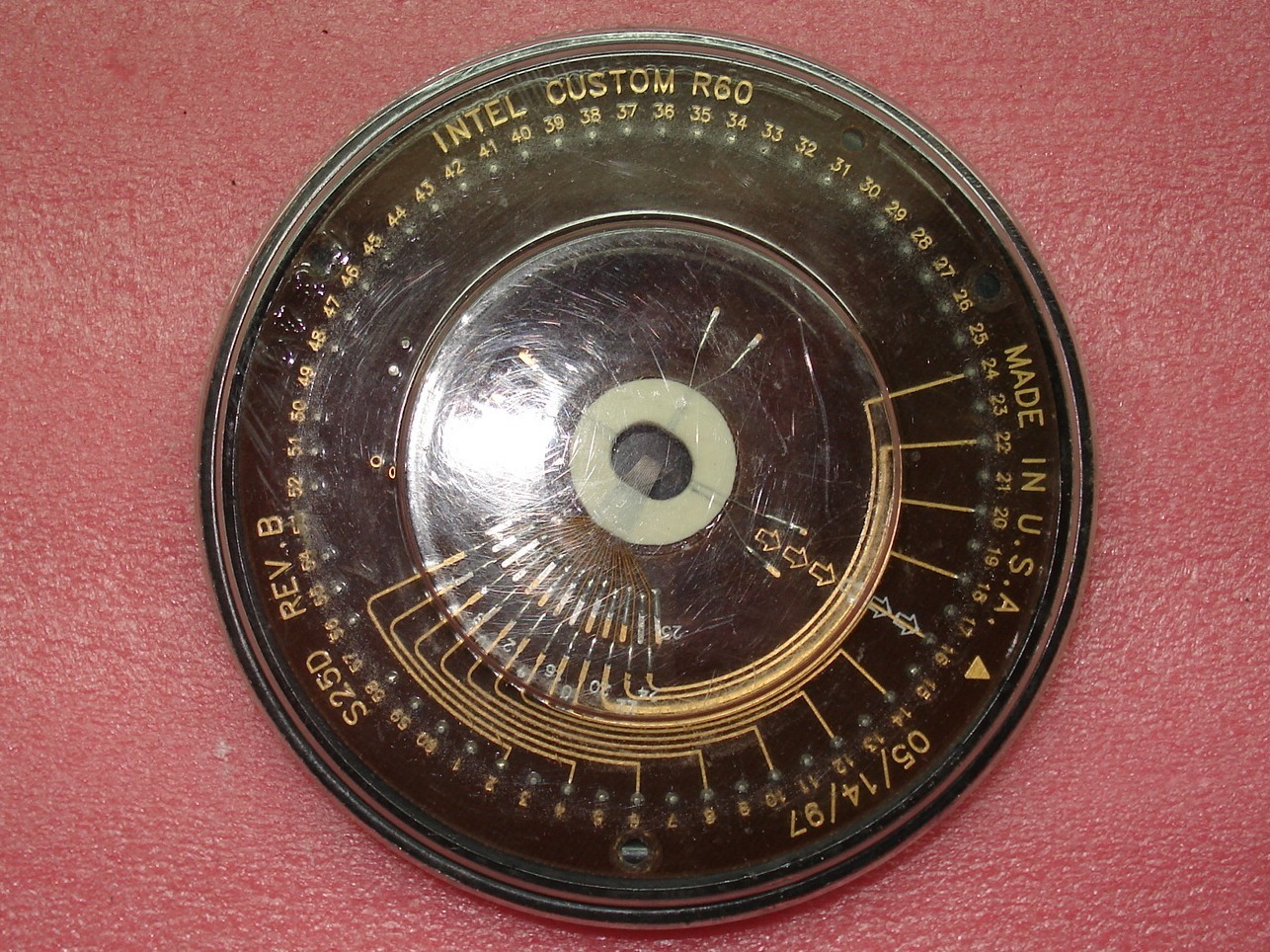
MicroProbe INTEL CUSTOM R60 S25D REV.B


MicroProbe INTEL CUSTOM R60 SP46A REV.B


MicroProbe PCIN 40MP INTEL CUSTOM R60 S20AA REV.A


Intel Confidential Pentium P55C


montaż urządzeń elektronicznych SMD THT

Links